


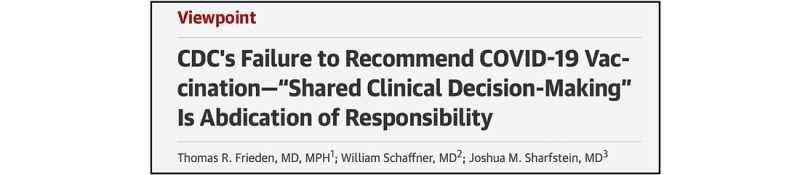
Former CDC director Tom Frieden and colleagues recently published a JAMA opinion piece condemning the CDC vaccine advisory committee’s endorsement of “shared decision-making” for future Covid-19 boosters.
They argued the shift was an ethical lapse—even an “abdication of responsibility”—particularly for older adults.
But what the CDC’s Advisory Committee on Immunization Practices (ACIP) proposed was nothing radical. It was the same patient-centered model that should be used across modern medicine.
Which is why the establishment’s reaction is so revealing: the moment the subject is “vaccination,” even the most basic principles of transparency and informed consent are treated as optional—or worse, as threats.
What ACIP is Actually Proposing
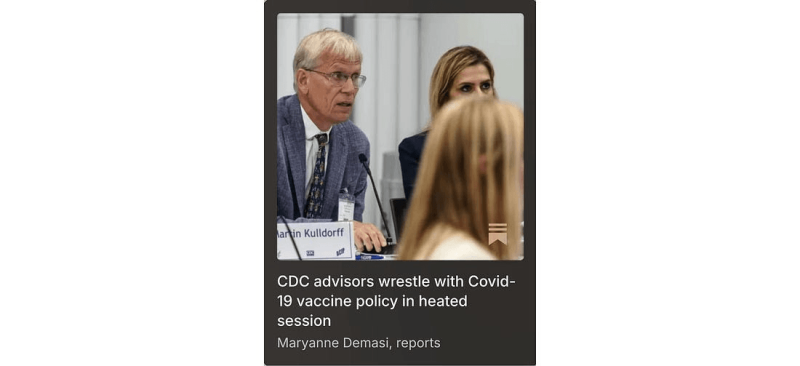
In September 2026, ACIP recommended that Covid-19 shots should no longer be a blanket policy but instead be decided through shared decision-making.
For older adults and those with underlying conditions, this meant discussing risks, benefits, and uncertainties with their doctors—and making a personalized choice.
This should be standard practice in nearly every other clinical scenario—prostate cancer screening, hormone therapy, antidepressant use in pregnancy, or cardiac surgery.
But vaccines have been placed on a pedestal. Questioning, hesitating, or individualizing the decision has been treated as heresy.
The unspoken rule is that both doctors and patients must “trust the science,” even when the science is evolving, and individual circumstances differ.
In that climate, ACIP’s recommendation wasn’t received as a return to ethical practice. It was seen as a direct challenge to a decades-old orthodoxy built on the idea that vaccine decisions are too sacred to be personalized.
The Claim That “Ambiguity Does Not Exist”
Frieden and colleagues insist that for older adults, the benefit–risk calculus is so clear that “ambiguity does not exist,” making individualized conversations not just unnecessary but potentially harmful.
They also warn that leaving such decisions to clinicians and patients creates a “vacuum” that other professional groups will rush to fill.
To defend the claim that there is no ambiguity in the benefit of Covid boosters for older adults, they rely heavily on observational data, including a 2025 Veterans study of 160,000 people reporting modest reductions in hospitalization and death among boosted recipients.
But like all observational research, the data have serious limitations.
The cohort was anything but uniform: different infection histories, different numbers of prior doses, and a high burden of chronic illness that elevates baseline risk regardless of vaccination.
“Real-world” data can offer insights, but it also carries real-world flaws—and it is not a sound basis for shutting down clinical dialogue.
A Shaky Analogy
The authors go further, suggesting that the benefits of Covid boosters for older adults are as absolute as vitamin K prophylaxis for newborns.
But equating a one-off, decades-validated intervention with repeated dosing of a novel mRNA platform in a highly variable adult population is scientifically and ethically indefensible.
Vitamin K is predictable, durable, and biologically straightforward.
Covid boosters operate in a shifting landscape: an evolved virus, continually updated formulations, divergent exposure histories, and dramatically reduced baseline risk.
The analogy works only if vaccines are treated as uniquely simple interventions—when in reality they involve far more complexity, uncertainty, and individual variation.
Why Conversation is Not “Abdication”
At the heart of the authors’ critique is the claim that ACIP “abdicates responsibility” by letting doctors and patients decide.
But that is the very purpose of medicine: to move away from paternalism and toward transparent presentation of evidence—a process that strengthens, not weakens, the relationship between doctor and patient.
Shared decision-making requires time, honesty, and respect. It ensures that even when the evidence is strong, patients understand the trade-offs and can choose according to their own values.
Ironically, Frieden and colleagues support this model in other contexts, such as prostate cancer screening, where no single “best choice” exists.
But when the discussion turns to vaccines, transparent conversations suddenly become dubious?
The issue is not the strength of the evidence. It is the cultural expectation that vaccine decisions should be insulated from personal preference—an expectation that has no place in ethical medical practice.
The Ethics of Informed Consent
Ethical standards should not shift depending on the intervention. Either informed consent applies to all medical treatments—including vaccines—or it is meaningless.
Frieden and co-authors also claim that “all vaccines are given only after informed consent,” a statement that bears little resemblance to many people’s lived experience.
Millions were coerced, mandated, or pressured into receiving vaccines they did not want—sometimes under threat of job loss, exclusion from education or restrictions on daily life.
Even pro-vaccine ethicists acknowledge that the US has no meaningful informed-consent process for vaccines.
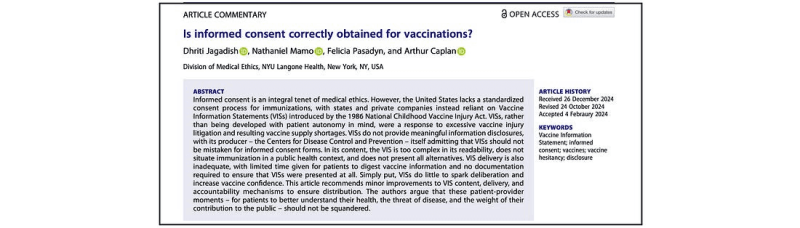
A 2024 commentary by ethicists at NYU Langone Health conceded that the CDC’s consent form (Vaccine Information Statement) “does not provide the understanding” required for informed consent and is often handed out after the injection.
And the CDC’s own actions recently demonstrate why honesty matters.
The agency quietly revised its autism guidance and acknowledged that its long-standing “vaccines do not cause autism” claim was “not evidence-based” because studies “have not ruled out” a possible link for vaccines given in early infancy.

This wasn’t a step backwards; it was a rare act of institutional honesty that restores trust, not undermines it.
The old habit of projecting absolute certainty onto complex questions—the habit Frieden now wants to preserve for Covid boosters—is precisely what damages trust and shuts down informed decision-making.
It leaves clinicians unable to speak plainly and patients unable to choose.
To me, that is the real abdication of responsibility. Informed consent is not a box to tick; it’s the foundation of trust between doctor and patient.
Health Care Workers are Not Convinced
The notion that patients cannot be trusted with vaccination decisions reflects a deeper belief that vaccines occupy sacred territory, somehow exempt from the norms of medical practice.
ACIP’s recommendation for shared decision-making on Covid boosters is one of the first meaningful departures from that mindset.
And healthcare workers themselves have already delivered a verdict. According to the CDC’s own data, fewer than 10% received a booster in the past year.
These are professionals with privileged access to data and daily exposure to Covid outcomes. If prior CDC leadership could not convince its own workforce, a return to mandates and moralising will not shift public opinion.
Trust Built on Honesty, Not Authority
There is a legitimate debate to be had about how best to protect older and medically vulnerable people from Covid in the years ahead.
But dismissing shared decision-making as an “abdication of responsibility” implies something else: that vaccination is too important to be left to personal choice, and that conversation itself is risky because it might lead to disagreement.
Outside of true life-saving emergencies, shared decision-making must be the default—not something officials discard when they want to push the population toward a particular policy goal.
We tried the coercive model during the pandemic, and it triggered the largest collapse in public trust in modern medical history.
If public health wants to regain credibility, it must stop treating vaccination as a protected category exempt from normal ethical standards.
Every medical decision begins with a conversation—and it seems ACIP is pointing back in that direction.
This article was originally published by the Brownstone Institute. Maryanne Demasi is an investigative medical reporter with a PhD in rheumatology, who writes for online media and top tiered medical journals. For over a decade, she produced TV documentaries for the Australian Broadcasting Corporation (ABC) and has worked as a speechwriter and political advisor for the South Australian Science Minister. Her work can be accessed on her website at maryannedemasi.com.



4 Responses
How ACIP deviates from the United States Prescribing Task Force:
https://karlkanthak.substack.com/p/how-the-acip-deviates-from-the-uspstf
The Cabal can’t survive when light shines on their criminal activity. Local physicians, care givers, relatives, next of kin . . . alll these people should participate in the decision process and give INFORMED consent. The big lie is that we – the none medically trained (aka the non-indoctrinated) can not understand the science enough to make good decisions. The truth is that if the people were aware and informed, most of these products would be discontinued. The profiteering of Medicine has taken over the practice of medicine and we are worse off for it. Doctors/healers have become purveyors of death and disease.
Criminal and despicable.
This was a surprisingly well written and rewarding article to read. Interesting writing strategy. Thanks Maryanne.
The core issue remains one of advocacy. Who’s advocating for who? Who’s prioritizing advocacy for a cause which is placed ahead of individual rights, best health outcomes and individual care? What is the benchmark for ‘ethics’? To advocate on behalf of patients or prioritize ‘public health’? Do the questions even matter?
The pertinent question; Are these people being paid to be advocates on behalf of one side or the other of the issue? It is an appropriate and intelligent response to first be informed of paid advocacy before giving credit to paid advocates positions or adopting their positions.
It is a fact that paid advocates are more likely to be deceptive. An advocates job is to push a certain viewpoint or position, find ways around objections, to dismiss counter positions. Advocates not only advocate for a certain position, but also advocate against other positions. This is the nature of advocacy.
A paid advocate can not be held in the same esteem or trust as an unbiased expert whom has not been paid to support a certain position. An advocate can simply never be accredited as an unbiased expert that anyone and everyone can trust at all times. To be ethical is to be trustworthy at all times. To be trustworthy to all is to be unbiased. Which means a person can not be a paid advocate and also maintain the ethical high ground.
This is the root of ethical arguments which are so routinely abused. These people don’t actually operate under constantly honest and ethical principals. Routinely accusing those whom disagree with them as being ‘unethical’. If you disagree with me that’s unethical, because; health. These are standard talking points whenever we are force fed another in an endless line of vaccination propaganda. Why so much of the general public does not trust these people or institutions and people.
The argument for mandatory or coercive vaccination strategy has always rested on dubious legal principals as well as illogical and often contradictory belief structures about who’s responsibility ‘personal health’ falls upon. So we end up with the untenable notion of ‘public health’. That everyone elses personal health is now our collective responsibility and it’s unethical to ignore these responsibilities.
This is contradictory to honest ethics, as ethics at it’s heart is behavioral in nature. Deciding the act of right vs wrong, responsible vs irresponsible behaviors, transparent and honest approaches vs non transparent dealings. Personal responsibility. We can not regulate honesty.
The arguments that CDC and other pro vaccination advocates put forth regarding trust in the establishment stand under the shadowy cloud of the undeniable scope and volume of runaway institutions. Pharmaceutical, research, educational, and insurance Institutions that are flush with cash, have unchecked power, have commandeered many operational structures from all forms of oversight and accountability.
The people no longer are empowered to vote on the matter. These institutions have secured a never ending always increasing stream of taxpayer funding. Their power comes from subjecting the public to taxation without representation. We think it’s rather obvious whom they’re advocating on behalf of, and whom they are not. Individual health concerns remain a secondary or even further down the list priority to business profits under this model.
How does informed consent and patient first prioritization co exist with operational models where advocates are basically in charge of everything in the first place? Where representative democracy no longer exists? Where market forces are no longer directed or even influenced by those whom utilize the service? Where companies and institutions receives continued funding despite market objections? Where the advocates always get paid even if the things they advocate on behalf of are dismal market failures? How can competing voices co exist with equal volume in a space where money is speech and one voice has unlimited funding, the other has almost none?
The arguments presented in this article are rational and meaningful. Yet are stated in such a manner, presuming legitimacy of existing constructs and current operational structure. The hard truth of the matter is we can not have a constant presence of advocates of this nature in health care, or we end up right back where we are now; Corporations prioritizing their own profits ahead of patient care.
Whatever meaningful contribution the government funded institutions had achieved is now constantly diluted and eroded by the sheer scale and size of the funding mechanisms. Nobody is ever going to prioritize patient first care ever again under this model.
There is no available rationale or argument which will ever supersede the current operational structure. Nobody will ever convince the profiteers and plunderers to depart from their free ride. Advocates of for profit interests stand in the way of patient first care. The people have no say in the matter. The death of informed consent, unbeknownst to many, occurred long ago.
The solution is simple; Free market principals. Take away the tax dollars which drive the current model. Force these companies to provide the consumer what the consumer wants, or there is no longer an income stream. Let the free market dictate the future of health care. Otherwise this runaway system will continue on it’s current trajectory.
Would anyone here have actually paid money out of their own pocket to make sure everyone else around them was vaccinated? If you paid for your own vaccine out of pocket, and it was effective, would you really pay hundreds of dollars more to ‘protect’ complete strangers?
The general public pays for the corporate advocates to make their statements. The corporate messengers only pay lip service to opposition. They really don’t care what you or I have to say or think on the matter. If they can force their product to market and force consumption, they will continue to do so. Your tax dollars, hard at work.
Back to the basics; No taxation without representation. Waste fraud and abuse always scales with the size of government. Centrally managed institutions always become co opted by the corporations they were formed to oversee, over time. The free market model is the solution which answers all other arguments and objections downstream. Which is why we say; Central planning never works. It’s all theater, the in fighting within an institution that will remain dysfunctional forever more. Policy for sale.
_________________
“When plunder becomes a way of life for a group of men in a society, over the course of time they create for themselves a legal system that authorizes it and a moral code that glorifies it.”
― Frédéric Bastiat
I went to med school with Frieden. He was in my class. What a disgrace he has become to Columbia P&S. A truly honorable institution of higher learning would revoke the degree of charlatans and humbugs like Frieden, who are unapologetic shills for the Vaccine Industry. Hand your head in shame, Dr. Frieden, and then go back to med school again and see whether you can pass a course in basic medical ethics.