


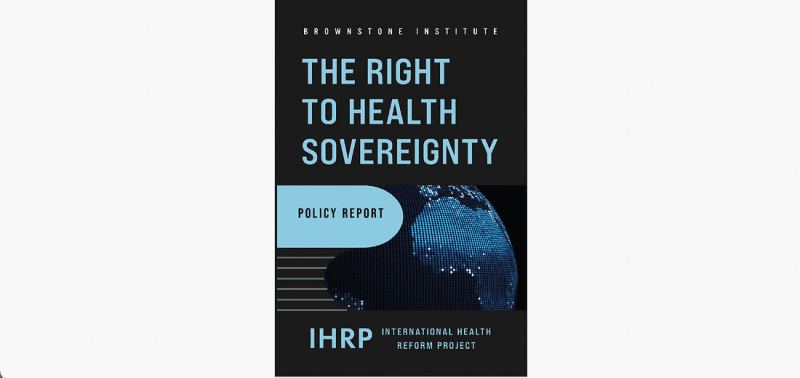
A 200-page policy report argues that global public health is no longer being driven by the needs of countries, but by financial incentives.
At the center of that argument is Professor Ramesh Thakur—a former Assistant Secretary-General of the United Nations and principal writer of Kofi Annan’s UN reform report.
He spent years inside the system helping shape it. Now, he argues that in public health, global authority has gone too far.
Thakur says decisions have shifted away from national governments and towards international institutions—particularly the World Health Organization.
The report was developed by a panel of global health and policy experts, co-chaired by David Bell, a former WHO researcher who has been openly critical of pandemic responses.
They are not just calling for reform—they are questioning the entire model: how it’s funded, how decisions are made, and who is actually in charge.
Follow the Money
The report argues that funding shapes everything.
Most of the WHO’s budget comes as voluntary contributions tied to specific programs. In practice, that means the money arrives with instructions.
The authors argue that this has quietly redirected attention.
Instead of focusing on broad health needs, the system leans towards areas that attract funding—outbreak response, vaccines, and large global initiatives.
For example, more than 80% of the WHO’s budget now comes from earmarked contributions tied to specific programs—such as vaccine campaigns, outbreak response, and disease-specific initiatives like polio or malaria.
Meanwhile, the basics—clean water, nutrition, sanitation, and primary care—receive less attention, even though they’ve historically delivered the biggest gains in health.
“The distortion of the global health agenda…has been enormous,” Thakur said.
Covid Was a Stress Test
These structural issues became more visible during the pandemic.
The report points to changing advice on masks, school closures, and population-wide restrictions. But its central concern is simpler: the same policies were often applied across very different countries.
“Governments…drove a fear campaign that exaggerated the threat,” Thakur said.
School closures are a clear example.
They were introduced in both wealthy and poorer countries, even though the risks to children—and the consequences of keeping them out of school—were not the same.
In some lower-income countries, schools remained closed for months despite much younger populations and far lower risk from Covid.
“We felt that acutely in Australia,” said Thakur. “One case occurs… and the whole state gets closed down.”
The report argues that global guidance was often followed, even when it didn’t fit local conditions.
“We witnessed the biggest expansion of state power—and in some cases, abuse of state power—around Covid,” Thakur said.
A Shift in Priorities
Importantly, the authors say this didn’t begin with Covid.
Over time, public health has shifted away from improving everyday conditions—water, food, sanitation, and basic care—and towards preparing for, and responding to, outbreaks.
That shift is partly driven by how risk is perceived.
Analyses of global outbreak data in 2025 suggested that the apparent rise in pandemics may largely reflect better detection, not more frequent events.
But once the expectation of global crises takes hold, funding follows. Preparedness becomes the priority, and long-term health problems receive less attention.
That shift is visible in where resources are directed—even though conditions like heart disease, cancer, and diabetes continue to account for most deaths globally.
The report’s argument is that this is no longer incidental—it is built into how the system operates.
What the Report Proposes
Against that backdrop, the report sets out a different approach: shifting control back to countries.
Under this model, local health services would deliver care, national governments would set policy, and regional groups would coordinate where needed.
Global organizations would still play a role—but a more limited one. They would share data, offer guidance, and support countries, rather than direct them.
Funding is central to this reset.
Instead of being tied to external programs, most funding would come from member countries. Private and philanthropic contributions would be smaller and fully transparent.
That change alone would alter what gets prioritized.
Governments would assess their own risks and decide how to respond, rather than applying the same approach everywhere.
Reform the WHO—Or Something More Drastic?
The authors are skeptical that small reforms will be enough.
“WHO as it exists is not fit for purpose,” Thakur said.
The panel argues that the current system is too entrenched, and raise the possibility of replacing it altogether if it cannot be reformed.
“You either reform it with deep reform…or replace it with a new organization,” he said.
In practical terms, that would mean building a new International Health Organization (IHO) based on a more decentralized model.
The United States has already withdrawn from the WHO, removing one of its largest funding sources. That shift in funding and influence adds pressure to an already changing system.
What Changes from Here?
The report ultimately lands on a clear position: that governments should take responsibility for public health decisions—how risks are assessed, how trade-offs are weighed, and how responses are chosen.
For low- and middle-income countries, where external funding often shapes health programs, that would mean greater control over priorities.
The recommendations are straightforward.
- Focus on basics like clean water, nutrition, and primary care
- Fund the system through member states, not donors
- Limit global bodies to advice and coordination
- Be transparent about funding and decisions.
What comes next is a fight over control—either the system tightens its grip, or countries move to take back sovereignty.
This article was originally published by the Brownstone Institute. Maryanne Demasi is an investigative medical reporter with a PhD in rheumatology, who writes for online media and top tiered medical journals. For over a decade, she produced TV documentaries for the Australian Broadcasting Corporation (ABC) and has worked as a speechwriter and political advisor for the South Australian Science Minister. Her work can be accessed on her website at maryannedemasi.com.



3 Responses
The structure of the governance is indicated by the language in their policies. Which is why free peoples should reject the validity of terms like public health, global health, global public health, global authority. These concepts are simply not legally binding. In their insatiable desire for more control and power, these global institutions have upset and harmed billions of people around the world.
The feigned surprise and subsequent call for restructuring of the global order which is steadfastly rejected by the masses is but one more piece of theater. Theater intended more for salvaging what is left of these institutions failing credibility, rather than any real admission of wrong doing or harm, any serious call to reform. Blanket immunity will be extended to everyone, nobody will be prosecuted. There will be new rules that member activities must be better balanced with a broader array of services provided rather than imbalanced focus on the most profitable endeavors which have been proven to do more harm than good. There is no reason to march in there, point at every single one of them and say; You’re fired, you’re fired, you’re fired, right down the line. They promised to behave better in the future.
Central planning never works. Restructuring these types of institutions is not a lasting solution. Decentralization is what leads to the innovation which allows for new technologies which will become widely adopted as having true and lasting beneficial applications for the people and their own societies. Whenever a central authority is involved at all, invention is stifled and abuse proliferates rapidly. No amount of reform will solve the core problem, that global institutions should not exist in the first place, their inevitable expansion will always result in far more end harm and abuse, and less beneficial technology and invention, than as if they never existed in the first place. There are too many moving parts and these institutions are not actually accomplishing what would otherwise be more simple to accomplish, if various individual decentralized problem solvers worked on problems in dynamic, different ways.
But you can’t sell ten trillion dollars of harmful vaccines with a mainline direct access to taxpayer funds around the entire world and become filthy stinking rich unless you have the centralized model in place. ‘The government actually cares about your health, and other hilarious jokes you can tell yourself in 2026.’
To do this properly would save lives, reduce profits and take serious manpower and change. Is there any evidence the WHO ,in its current format, has any interest in accomplishing any of the above?
I ‘m sad to see corporate money capture America. $$$$$
Nations coerced to accept money with stipulations of how to use it is somewhat a bribe for control!
We really don’t need an over abundance of wealth.
My desparate appeal is to provide CLEAN WATER, NUTRITION, SANITATION & PRIMARY CARE!
We can do this!!!
Thank you.