


In a survey of health policy conducted and published in Health Policy by the Cornell University Health Policy Center, a majority of 62 “health care policy experts” participating in an “Insight Panel” said they believe that weakening liability protections for drug manufacturers would substantially reduce pharmaceutical innovation and increase prices for existing vaccines. Several of the panel participants surveyed stated they also believe that making pharmaceutical companies more liable for vaccine injuries and deaths in a civil court of law could lead some manufacturers to stop investing in research and development of new vaccines, and about half said increased liability could impact the willingness of physicians to administer vaccines to patients. Since doctors administering vaccines don’t want to be vulnerable to medical malpractice lawsuits, some suggested doctors may become less willing to administer or promote use of vaccines if there is more liability for vaccine manufacturers.1
Several of the health care policy experts panelists surveyed referenced a 2004 paper published in the Quarterly Journal of Economics, which concluded that policies that promoted and incentivized vaccination and reduced legal liability for vaccine injuries and deaths led to an increase in the number of clinical trials for new vaccines and facilitated research and development of new vaccines.1
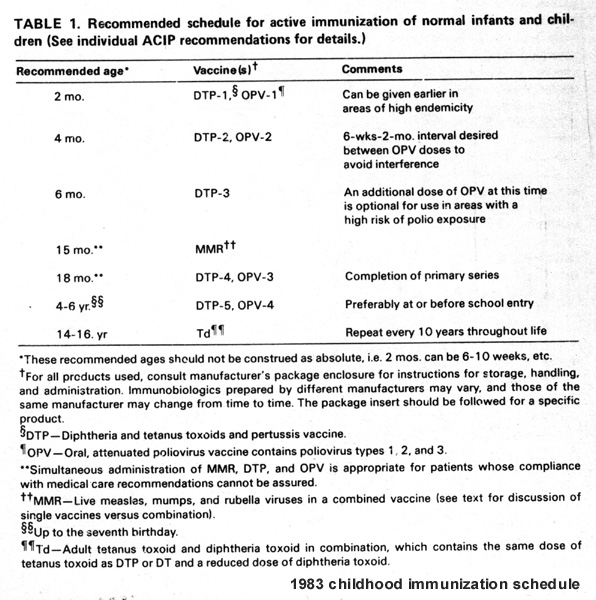
Evidence for this is reflected in the expansion of the federally recommended childhood vaccine schedule over the past four decades. In 1983, the U.S. Centers for Disease Control and Prevention (CDC) recommended 23 doses of seven vaccines—live polio vaccine (OPV); diphtheria-pertussis-tetanus (DPT); and measles-mumps-rubella (MMR)—which were administered between two months and six years old. By 2023, the schedule had expanded to 72 doses of 17 vaccines given between the day of birth and age 18.2 3
1982 TV Documentary, Parents of DPT Vaccine Injured Children Prompted Threats and Disinformation from Vaccine Manufacturers
In the spring of 1982, after the national broadcast of the Emmy award winning television documentary “DPT: Vaccine Roulette”4 the charity Dissatisfied Parents Together (DPT) was founded in the Washington, DC area by parents of DPT vaccine injured children, who began lobbying for a less reactive acellular pertussis vaccine.5 The response by manufacturers of DPT vaccine (Wyeth, Lederle, Connaught) was to threaten to leave the country with no childhood vaccines unless Congress gave them total liability protection from vaccine injury lawsuits.
This blackmail by the pharmaceutical industry was based on a false narrative that vaccine injury lawsuits were driving vaccine manufacturers out of business when, in truth, there were only a few high profile multi-million dollar jury awards for plaintiffs and the majority of court cases were settled on the courthouse steps after wealthy drug companies and their attorneys dragged out court cases so that exhausted, cash poor parents caring for vaccine injured children would settle for low sums of money. Then, DPT vaccine manufacturers claimed there were pertussis vaccine shortages and the need for DPT price increases because of financial losses from vaccine injury lawsuits—even though evidence presented in congressional testimony proved that to be completely untrue.6 7 That false narrative continues to be often repeated today.8
Congressional Hearings and 1986 National Childhood Vaccine Injury Act
After the broadcast of “DPT: Vaccine Roulette” and threats from vaccine manufacturers, congressional staff members informed parents of DPT vaccine injured children that Congress was going to protect the childhood vaccine supply with federal legislation. There were a series of congressional hearings held between 1982 and the end of 1986, during which time the National Childhood Vaccine Injury Act was created by a bi-partisan group of congressional staff members and “vaccine stakeholders,” that included parents of DPT vaccine injured children, American Academy of Pediatrics (AAP) leaders, federal health officials, and vaccine manufacturer representatives.9
The 1986 Act,10 which was signed into law by President Ronald Reagan in November 1986, was historic acknowledgement by the U.S. government that federally licensed and recommended childhood vaccines mandated by states for children to attend school can injure and kill; that vaccine safety should be made a national priority; that vaccine injured children should be provided with a non-adversarial, expedited and more just administrative federal Vaccine Injury Compensation Program (VICP) alternative to suing a drug company, and that doctors negligently administering vaccines should continue to be liable in civil court for medical malpractice and drug companies should continue to be liable for product design defect in the manufacture of vaccines.
Reagan Reluctantly Signs Act After Parents Secured Vaccine Safety Provisions and Protected Lawsuits Against Vaccine Makers and Administrators
The parent co-founders of Dissatisfied Parents Together, which in 1989 became the National Vaccine Information Center (NVIC), were responsible for securing vaccine safety informing, recording, reporting and research provisions in the law and for ensuring it did not shield doctors administering vaccines from medical malpractice lawsuits and that parents could continue to sue vaccine manufacturers for product design defect when there was evidence a company could have made a vaccine less reactive. After President Reagan reluctantly signed the Act into law in 1986 over the objections of the Department of Justice because it did not eliminate all product liability for vaccine manufacturers or medical malpractice liability for vaccine administrators,11 in 1987, Congress quietly added an amendment to the law eliminating medical malpractice lawsuits against negligent vaccine administrators.12
Then, starting in the early 1990s and over the next three decades, additional congressional amendments and rule making by the Department of Health and Human Services severely weakened vaccine safety and vaccine injury compensation provisions.13 14 In 2011, the U.S. Supreme Court majority ruled in Bruesewitz v. Wyeth that childhood vaccines are “unavoidably unsafe” and effectively removed all liability for vaccine injuries and deaths from vaccine manufacturers.15
Often referred to as the “Vaccine Court,” the administrative federal Vaccine Injury Compensation Program (VICP) requires vaccine injured individuals or the families of those who have died after vaccines, which are recommended by the federal government for children, to sue the Secretary of Health, who is represented by Department of Justice (DOJ) attorneys in Vaccine Court. The vaccine injured are represented by privately retained plaintiff attorneys, with contested cases being argued in the U.S. Court of Federal Claims in Washington, DC.
Money to fund federal compensation awards comes from a 0.75 cent tax applied by vaccine manufacturers to every dose of a covered vaccine and that money is held in a Trust Fund managed by the U.S. Treasury. COVID-19 vaccine injury claims are handled through a separate Countermeasures Injury Compensation Program (CICP). Created by Congress in 2005, the COVID-19 biological was added to the CICP in March 2020.16
How the VICP Works
As the system currently operates, when a person has experienced a vaccine-related injury, a claim can be filed with evidence, such as medical records and other documentation, which is reviewed by officials at the U.S. Department of Health and Human Services (DHHS). If federal health officials believe the vaccine(s) caused the injury or death, and the injury is included on the Vaccine Injury Table in the Act and qualifies for automatic administrative compensation, an uncontested award is made to the claimant. However, if the vaccine injury claim is contested by Department of Health officials as not being related to the vaccine(s) given, plaintiff’s attorneys and DOJ attorneys will present evidence, including expert witness testimony, to a special master in the U.S. Court of Federal Claims in Washington, DC, who will make a ruling about whether or not the claimant receives an award.17
The list of injuries to receive automatic compensation can be found here. Since its establishment, the VICP has paid out $5 billion to around 13,000 claimants.18
Founders of DPT/NVIC Have Publicly Criticized the Destruction of the 1986 Act and VICP for Four Decades
The 1986 Act was a law that was designed to elevate vaccine safety to a national priority and provide “simple justice for children,” especially for vaccine injured children whose parents do not have the financial resources to sue vaccine manufacturers or negligent doctors in civil court. In congressional testimony, legal actions, and public comments for federal vaccine advisory committees, U.S. health agencies and the media, the founders of Dissatisfied Parents Together (DPT)/National Vaccine Information Center (NVIC) have protested the destruction of vaccine safety and compensation provisions in the National Childhood Vaccine Injury Act of 1986.19 20 21 22
The Congress, Departments of Health and Human Services and Justice, and the U.S. Supreme Court together participated in the ruination of the Act, including the Vaccine Injury Compensation Program administrative alternative to a lawsuit. If the Act had been allowed to function as it was when it became law in 1986, parents would be provided with complete and truthful information about vaccine and disease risks before their children are vaccinated; doctors would be required to obey the Act’s requirement to report reactions, injuries and deaths that occur after vaccination to the federal Vaccine Adverse Event Reporting System (VAERS); DHHS would have fully complied with vaccine safety research provisions in the Act; and children required by states to receive federally recommended vaccines to attend school would be quickly and generously compensated for vaccine injuries.
Most importantly for those now suffering with injuries from the mRNA COVID-19 biological labeled a vaccine, if the US Supreme Court had not eliminated design defect liability from vaccine manufacturers, today that mRNA product would be subject to product design defect lawsuits in civil court. Even so, plaintiff’s would still face severe restrictions on product liability and medical malpractice lawsuits due to tort reforms instituted in many states over the past four decades.23
Proposed Reforms for the VICP
Anna Kirkland, a professor of law, health, and medicine at the University of Michigan has stated it is her opinion that there are “friendly amendments with bipartisan support” needed to improve the VICP, such as hiring more special masters to hear the vaccine injury cases that have dramatically increased as more vaccines have been added to the childhood vaccine schedule by the CDC. She also suggested increasing certain compensatory damage caps set at $250,000 and changing the statute of limitations for filing claims which is currently set at three years.24
In recent years, U.S. Secretary of Health and Human Services Robert. F. Kennedy, Jr. and others have criticized the VICP as being inefficient and biased in favor of the government’s position that vaccine injuries and deaths are “rare.” Secretary Kennedy has called the program “biased” against those seeking compensation, slow, complicated and unfair to victims. Some have called for total repeal of the 1986 Act, which would take an act of Congress, Kennedy has said he wants to “revolutionize” the vaccine injury compensation program.24
In September 2025, Bloomberg News reported that Kennedy was considering adding more injuries to the Vaccine Injury Table, such as certain symptoms of autism, so those injuries can be recognized and compensated. Although the Secretary of Health has the authority to add, subtract or modify the list of symptoms and conditions eligible for federal vaccine injury compensation, the changes would likely be required to go through a regulatory process that would take time to complete.”25
Some Question If Changes to Vaccine Schedule Will Change Liability Shields
At the beginning of this year, the Advisory Committee on Immunization Practices (ACIP) recommended and Kennedy reduced the number of federally recommended childhood vaccines to more closely match the childhood vaccine schedule of Denmark and other European countries. Some have alleged that this could open the door to removing liability protection for non-federally recommended vaccines for children.
“Some legal experts aren’t so sure that there’s an immediate opening to strip away liability shields but see the changes by Kennedy and his aides as a step in that direction, making it easier to sue vaccine manufacturers over injuries believed to be caused by the shots,” reported Stat News. HHS maintains that the changes in the schedule do not affect liability protections but vaccine manufacturing industry leaders are expressing concern about losing liability protections for some vaccines recommended for children (which are also given to adults, including pregnant women) and do not want long standing national vaccine policies to change.”26
Authors of the article in Health Affairs, which reported on the Cornell University Health Policy Center findings, write:
Although there are few details regarding specific proposed reforms, changes to the program could include removing certain vaccines from protection; allowing more litigation outside of the VICP; adding more conditions to the list eligible for compensation, including those without an established link to vaccines; and making the vaccine manufacturer, instead of the federal government, the defendant in vaccine-injury cases.1
Congress has the authority to repeal damaging amendments and rulemaking made to the historic 1986 Act so it returns to its original form when it became law in November 1986. This action would not only truly make vaccine safety and meaningful scientific research a national priority but would provide a fully functioning non-adversarial federal compensation system alternative to filing a lawsuit. At the same time, negligent doctors and other vaccine administrators would be liable for medical malpractice and pharmaceutical corporations would be liable for product design defect in the manufacture of vaccines.27
If you would like to receive an e-mail notice of the most recent articles published in The Vaccine Reaction each week, click here.
Click here to view References:1 Khullar D et al. Experts: weakening vaccine liability protections would increase prices and reduce innovation. Health Affairs Mar. 18, 2026.
2 U.S. Centers for Disease Control and Prevention. Recommended schedule for active immunization of normal infants and children, 1983.
3 CDC. Recommended Immunizations for Birth Through Six Years Old, United States, 2025.
4 Hilts D. TV Report on Vaccine Stirs Bitter Controversy. The Washington Post Apr. 28, 1982.
5 Institute of Medicine. Appendix B – Pertussis and Rubella Vaccines: A Brief Chronology – 1982-1986. In: Adverse Effects of Pertussis and Rubella Vaccines. National Academy of Sciences 1991.
6 U.S. House Health and Environment Subcommittee. Testimony of Jeffrey Schwartz, President of Dissatisfied Parents Together on DPT vaccine shortages. Dec. 18, 1984.
7 House Health and Environment Subcommittee. Testimony of Jeffrey Schwartz, President of Dissatisfied Parents Together (DPT) on the myth of DPT vaccine shortages, DPT vaccine manufacturer economic losses and need for DPT price increases. July 25, 1986.
8 The College of Physicians of Philadelphia. Vaccine Injury Compensation Programs. Apr. 19, 2022.
9 U.S. Senate Labor and Human Resources Committee on S.2117. Testimony of Jeffrey Schwartz, President of Dissatisfied Parents Together (DPT). Pages 46-60. May 3, 1984.
10 Public Law 99-660. Title III – National Childhood Vaccine Injury Act of 1986. 42 USC 300aa (including subsequent amendments after the law was passed by Congress). Nov. 14, 1986.
11 President Ronald Reagan. Statement on signing the State Mental Health Bill, which contained the National Childhood Vaccine Injury Act of 1986. Nov. 14, 1986. Ronald Reagan Presidential Library and Museum.
12 U.S. Congress. Omnibus Budget Reconciliation Act of 1987 (Public Law 100-203). Subtitle D – Vaccine Components. Sec. 4306. Vaccine Administrators. Pg. 224. Dec. 22, 1987.
13 .S. House of Representatives. H.R. 2202 Preventive Health Amendments of 1993. Section 708: Simplication of Vaccine Information Materials. Sponsor: Henry Waxman (D-CA).
14 Fisher BL, Wrangham TK. Public Comment to DHHS Health Resources Services Administration (HRSA) Opposing Changes to the Vaccine Injury Table. Jan. 25, 2016.
15 Supreme Court of the United States. Bruesewitz v. Wyeth No. 09-152. Justice Scalia delivering majority opinion. / Dissenting Opinion by Justices Sotomayor and Ginsburg. Feb. 22, 2011.
16 Health Resources Services Administration. Countermeasures Injury Compensation Program (CCIP). May 2026.
17 HRSA. Vaccine Injury Compensation Progam: How Does the VICP Work? June 2026.
18 HRSA). Vaccine Injury Compensation Program Data & Statistics. June 1, 2026.
19 Fisher BL. Compensating Vaccine Injuries: Are Reforms Needed? Testimony for U.S. House Subcommittee on Criminal Justice, Drug Policy and Human Resources. Sept. 28, 1999.
20 Fisher BL. The Vaccine Injury Compensation Program: A Failed Experiment in Tort Reform. National Vaccine Advisory Committee Feb. 27, 2023.
21 Fisher BL, Williams K, Wrangham TK. Response to GAO Inquiry on Implementation of the Vaccine Injury Compensation Program of the National Childhood Vaccine Injury Act. National Vaccine Information Center July 11, 2014.
22 Fisher BL. 1986 National Childhood Vaccine Injury Act: MYTH vs. FACT and Barbara Loe Fisher January 2024 Interview about the 1986 Act with Del Bigtree on “Highwire.” National Vaccine Information Center Jan. 4, 2026.
23 Fisher BL. Position of NVIC on the 1986 Act. National Vaccine Information Center February 2018.
24 Kirkland A. RFK Jr.’s plans to overhaul ‘vaccine court’ system would face legal and scientific challenges. The Conversation Aug. 15, 2025.
25 Reuters. US health secretary Kennedy considers adding autism symptoms to vaccine injury program, Bloomberg News reports. Sept. 25, 2025.
26 Cirruzzo C, Payne, D. Slashing of U.S. vaccine schedule creates new uncertainty on manufacturers’ legal protections. Stat News Jan. 8, 2026.
27 Fisher BL. Position of NVIC on the 1986 Act. National Vaccine Information Center February 2018.


13 Responses
So, who were those 62 “health care policy experts” on this “Insight Panel,” how much $$$ do each of them make from the for-profit “healthcare” industry in their salaries and/or from their investments, and how many vaccines have they themselves and their immediate families received over the years?
You’re on the right track with that thought process Jill. Same as with any other subject matter and relation of peoples; There must be a foundation of trust to move forward on anything.
In their hubris, the arrogance of entitlement, they presume the general public must trust them, for the public’s own good. Under these conditions they lose focus on what is and what is not beneficial for the human condition. They lose track of what is health care. Lost in the minutia.
They are not practicing health care, although they think they are, they really do. They are actually practicing coordinated business strategy; how to navigate complex bureaucratic frameworks. Who doesn’t want a better paycheck, at least a continued one?
Great, big pharma can continue to kill people with no accountability with their vaccines. They make billions of dollars on their vaccines, but oh no, they can’t be held accountable for the deaths they cause. And then their is our government mandating vaccine wether you want it or not. Wow, what a bunch of bull.
Follow the money. They’ll continue to slow walk everything, forever, indefinitely. That is in fact the modus operandi and path to their financial success. The people continue to play along. Be them supporters or resistors, the fact they operate and communicate within the prescribed frame work that vaccines can be legitimate in the first place keeps the show rolling on another day, week, month, year, decade, century, and so on and so forth. This has been the same routine for nearly two and a half centuries already.
There is always a new expert to call. Always another important debate to be had. New products and new wares are constantly brought forth, reformulations of the reformulation again, and again, and again. Then the debate starts anew, rinse, repeat.
What you’re really observing, but they can’t outright come out and say this; Is the attempted de hypnotization of the zealots within the system who’s entire life and belief set is formed around this framework of lies, as well as public outreach in an attempt to slowly pull the public back from the trained behaviors they have been taught their entire lives.
You’ll get sick and die a horrible death if you don’t take that vaccine buddy. We’ll use every heavy handed coercive effort and you’ll pay the dear price, and then you’ll die anyways for not being a believer like the rest of us.
Seeking enlightenment, better understanding the human condition, your condition, breaking the mind control, recognizing propaganda and fear mongering for what it is. Comes with a price. This is a real life horror movie and they are real life cult members whom sit in positions of substantial power. There is a new actor on stage, running around with a stop watch attempting to get past the herd mentality, dehypnotize several billion people all at once. Might as well be a script for resident evil.
We’re glad someone is trying to enact reforms from the inside. The centralization so entrenched though, the propaganda so well established over generations after generations. They’ll make some progress but will ultimately be subject to the same primary condition how this racket became so well established in the first place. They’ll run out of time and the entire thing will start all over again with the new people, the new products, the next generation of propagandized masses.
Or you could simply opt out on the basic principal; Good ideas do not require force. When someone tries to make you do anything, it’s rarely in your best interest. The principal that central planning never works. The end result of centralization, which brings the central planners and bureaucrats into power, is that the absolute power corrupts absolutely. See past the complexity of ‘medicine’ and all the challenging lingo thereto. These people are not experts. What they are doing is not science.
The reluctance of vaccine manufacturers and those administering vaccines to accept liability for injury and death caused by these products confirms they know vaccines cause harm. If they truly believed vaccines are safe, they would not hesitate to accept liability. I suggest that what is being revealed by these “health policy experts” is a moral deficit where they know vaccines cause harm but support the practice nevertheless.
Follow the money. 62 percent of the experts prefer no risk of lawsuits for a product that causes harm. About the only thing I can do as a private citizen to protect myself is refuse to accept the shot. I didn’t get any COVID shots, just took Ivermectin once a month, and had no symptoms or COVID experience.
But it is such a shame that this industry is so highly thought of.
BRAVO! Another comprehensive and fully referenced TVR article explaining the complexities of the 1986 Act and VICP in plain language so everyone can truely understand. An important read, especially for all those who think they know better, but don’t. Thank you!
If that’s the way they’re going to do it, with no concern for the harm they’re causing to human health, then the only fair thing to do is to make vaccines 100% voluntary. Publish accurate data on the safety of the vaccines completely accessible to the public and let people choose if they want to take the risk. Also, publish the names of that panel of 62 that doesn’t want to make drug companies liable for harm and how much money they are receiving from drug companies. Right now there is no informed consent and no transparency, just windfall profits for the drug companies.
Every one of those 62 Health Care Policy “Experts” has been bought by Big Pharma!!
Lies and Bribery are ‘business as usual’ for Big Pharma!!!
Did the servay ask if more harmful vaccines will make healthier children?
That is why I don’t answer any servers.
They just want to know what will bennifit themselves.
Important to understand how we got here, to better equip ones self for dealing with these people and their systems.
https://thehfdf.substack.com/p/part-three-the-2014-ebola-outbreak
The root cause is anyone trusts these people and corporations in the first place.
Congress… Appeal to the congress critters, most of them are for sale like the rest.
Your only real form of resistance is to vote with your wallet, vote with your feet. To understand and embrace the principals of liberty, that nobody is in control of your life except you.
However, as you’ll learn if you dig deep and muster the fortitude to read the HFDF deep dive into disease outbreak, you’ll realize how long this has been going on, in all it’s various forms, for longer than you’ve been alive. Regrettably, you’ll still need tires on your car.
Central planning never works. What those people are doing is not science. They are not experts.
So, have I got this straight: “Unless we have legal protection, we’re going to stop poisoning you.”
The cattle are so brainwashed by the ‘medical’ psyop that they can’t bear to be left without their poison injections.
if manufacturer don’t trust their vaccine , why should parents? would people trust vaccines more if the manufacturer is liable? would manufacturer make vaccines safer and less toxic if they were liable?
No liability protection = safer vaccines + less parent hesitation + more manufacturer hesitation.